
How Often Should You Seal Stone and Grout in an Orange County Home?
Every sealer wears out, and in Orange County it wears out faster than the label says. Here is a straightforward guide to how often travertine, marble and grout actually need resealing — and how to check in ten seconds.
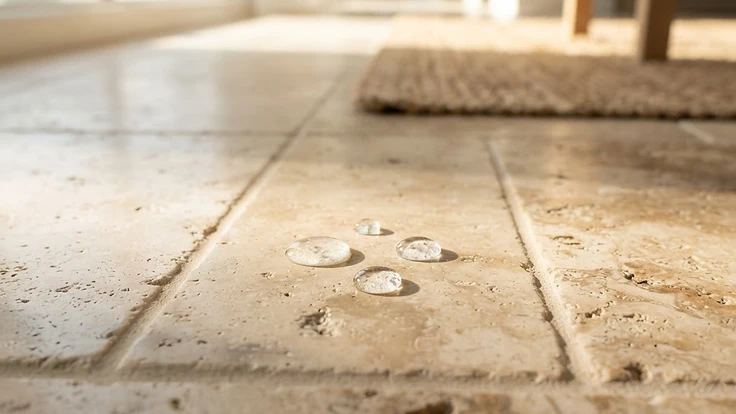
It is one of the most common questions we get, and one of the most poorly answered online: how often does stone actually need to be sealed? The usual advice — "every one to three years" — is a manufacturer's figure measured in a laboratory, not in an Orange County home with hard water, intense sun and a family walking across the floor every day. The honest answer is that the interval depends on the surface, the sealer, the traffic and the exposure, and the only reliable way to know is to test the surface rather than trust the calendar. That said, there are useful rules of thumb, and knowing them saves both money and damage.
What a sealer actually does — and does not do
Before the intervals make sense, it helps to be clear about what sealing is for. A penetrating sealer soaks into the pores of stone or grout and lines them, so liquids sit on the surface long enough to be blotted instead of soaking in immediately. That is all it does. It is a stain-resistance measure and a time buffer, not a shield.
A sealer does not prevent etching. Acids — vinegar, wine, citrus, coffee — will still dissolve the calcium carbonate in marble, travertine and limestone whether the stone is sealed or not. It does not prevent scratching from grit and furniture, and it does not make a worn, dull floor look new. If a stone floor has gone cloudy and flat, the fix is refinishing, not resealing. Sealing protects the surface you have; it does not repair the surface you have lost.
On grout, the logic is the same but the stakes are higher. Grout is genuinely porous and it is the part of a tiled floor that collects everything: grease, soil, hard-water minerals, pet accidents. A sealed joint can be wiped clean; an unsealed one absorbs the stain permanently. That is why grout colour sealing — which both seals and recolours — is such a common request on older Orange County floors.
The five-year myth
Topical sealers are sometimes sold with "five-year protection" claims. Those numbers assume indoor conditions, moderate traffic and a clean, well-maintained environment. In an Orange County home with west-facing glass and a family, the same product will often need refreshing in half that time. A sealer that beads water beautifully in year one can be fully open by year three, and nothing about its appearance will tell you. The surface will look exactly the same right up until the day a spill soaks in and stains.
That is the trap: sealers fail invisibly. The only way to know is to test.
The ten-second water-drop test
This is the single most useful maintenance habit for any stone or tile surface. Put a few drops of water on the surface in a spot you will not immediately wipe up, and watch.
- The water beads and stands proud. The sealer is intact. No action needed.
- The water flattens and spreads slowly. The sealer is thinning. Plan to reseal within the next few months.
- The water soaks in and the stone darkens. The sealer has failed at that spot. Reseal now — and check the rest of the room, because failure is rarely isolated.
Test in the places that take the most abuse: the traffic lane through the entry, in front of the kitchen sink, the shower floor and the edge of the pool deck. Those are the areas that will tell you the truth first.
Stone floors: a realistic interval
For interior travertine, limestone and marble floors in Orange County homes, a penetrating sealer typically holds for two to three years on low-traffic floors and one to two years in busy entries, kitchens and hallways. Honed and tumbled finishes absorb more sealer and often hold longer than a high polish, where the sealer sits closer to the surface.
Marble countertops are a different case. They see oil, wine, citrus and coffee directly, and they get wiped constantly. An annual reseal on kitchen counters is sensible, and a quick touch-up around the sink and the edges — the two areas where sealer goes first — is often enough between full reseals.
Grout: seal more often than you think
Grout deserves a shorter cycle than most homeowners expect. On a tiled floor with normal household traffic, a sealer will realistically hold one to two years before it needs refreshing. In a shower, where the joint is wet daily and Orange County's hard water deposits minerals into the pores, annually is the right rhythm — and in a shower that has already been colour-sealed, a maintenance coat every couple of years keeps it looking freshly done.
Unsealed grout in a kitchen or bathroom, by contrast, is a stain waiting to happen. If a floor has never been sealed, the first step is a deep clean to remove what has already soaked in, then a sealer or colour sealer applied to clean grout. Sealing over soiled grout simply locks the soil in.
Outdoor stone: shorter cycles, different products
Outdoor surfaces live harder lives. UV exposure, rain, irrigation, pool chemistry and coastal salt air all shorten a sealer's life dramatically, and Orange County provides all of them. A travertine patio or pool deck typically needs resealing every two to three years — sometimes sooner near the coast or if the deck gets heavy splash. Use a breathable penetrating sealer rated for exterior use; a non-breathable coating on exterior stone traps moisture and drives efflorescence instead of preventing it.
Salt air along the Newport, Huntington, Laguna and San Clemente coastlines is its own factor. Homes within a mile or two of the water should assume the shorter end of every interval, on both interior and exterior surfaces, because airborne salt is relentless and corrosive.
What shortens a sealer's life
Beyond traffic and sun, a few habits quietly strip sealer faster than anything else.
- Acidic cleaners. Vinegar, citric-acid products and most "descaling" sprays attack both the sealer and the stone. A pH-neutral cleaner is the only correct choice for natural stone.
- Abrasive scrubbing. Scouring pads and harsh brushes physically wear the sealer off the surface.
- Bleach. Common on grout, and it breaks down sealers while discolouring the joint.
- Mopping with too much water. Standing water and detergent residue leave a film that dulls the surface and can degrade the sealer.
A simple schedule that works
If you want a plan rather than a test-every-time approach, this is the rhythm we recommend for most Orange County homes:
- Kitchen stone counters. Reseal annually; blot spills immediately and keep a pH-neutral cleaner at hand.
- Interior stone floors. Reseal every one to two years in busy areas, two to three in quieter rooms — and always confirm with the water-drop test.
- Tile grout. Refresh every one to two years; reseal showers annually.
- Outdoor decks and patios. Reseal every two to three years, and every year or two within a mile of the coast.
- After any restoration. Always reseal — polishing and honing open the stone's pores, and a freshly restored surface is the most absorbent it will ever be.
The bottom line
Sealers are maintenance, not permanent coatings, and the right interval is the shortest one your surface actually needs. Test before you spend: if water beads on the entry floor and soaks into the shower grout, the floor needs nothing and the shower needs attention now. Ten seconds with a few drops of water will tell you more than any label ever will.
If you are not sure whether your stone or grout has any sealer left, a free assessment will test the surfaces and show you exactly what needs resealing — and what needs more than a sealer to look its best again.
Want this handled professionally?
Our Orange County technicians clean, seal and restore tile and stone of every kind — with free, no-obligation quotes.