
Orange County's Hard Water: What It Does to Your Shower Tile and Glass
Orange County has some of the hardest water in California. Here is what it does to your shower tile, grout and glass — and what actually removes the white scale a squeegee cannot.
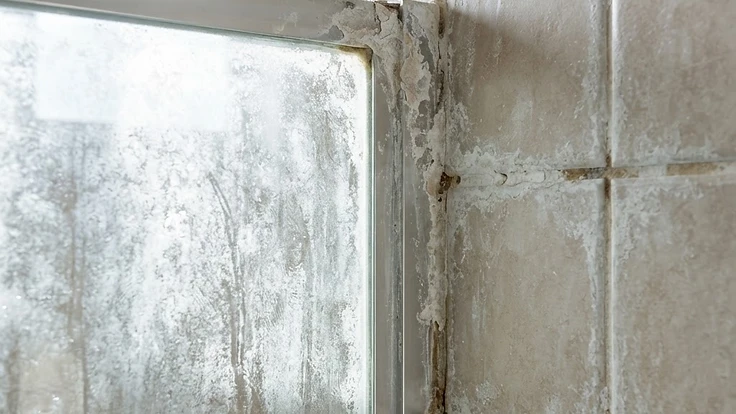
If you live in Orange County, you already know the white crust that builds up on your shower glass, faucet heads and grout lines. That is hard water — and our region sits on some of the most mineral-saturated municipal water in the state. Calcium and magnesium dissolved in the water supply are left behind every time a drop evaporates, and in a shower that happens dozens of times a day. Over months and years, those deposits bake onto tile, grout and glass in a layer that no household cleaner can dissolve.
What hard water actually does
The white film on your shower glass is calcium carbonate scale. It is not soap scum, and it is not dirt — it is a mineral crust bonded to the surface. On glass, it starts as a cloudy haze and progresses to a rough, chalky crust that etches the glass itself if left long enough. On grout, the minerals soak into the pores and crystallise, turning pale grout yellow, then orange, then brown. On polished marble and travertine, the scale bonds so tightly that removing it without scratching the stone underneath is a job for professional-grade chemistry, not a scrub pad.
The hidden problem is what hard water feeds. The same mineral deposits that crust on your grout also create the perfect porous surface for mould and mildew to anchor in. A shower that seems to grow pink and black mould overnight is almost always a hard-water problem first — the scale gives the mould something to root into that a squeegee will never reach.
Why household cleaners make it worse
Most supermarket shower cleaners are acidic — they contain vinegar, citric acid or other acids meant to dissolve mineral deposits. On glass and ceramic, that is sometimes enough. On natural stone — marble, travertine, limestone — those same acids etch the stone itself, replacing the hard-water haze with permanent dullness. On grout, acidic cleaners strip the sealer and open the pores to even more staining. And on glass that has already been etched by scale, an acid cleaner can make the cloudiness worse, not better.
The other common approach — abrasive scrubbing — physically scratches glass, stone and grout, leaving micro-abrasions that collect scale faster the next time.
What actually works
- Professional descaling. Commercial-grade, stone-safe descaling agents dissolve calcium and magnesium deposits without etching the surface beneath. This is the only way to remove baked-on scale from marble, travertine and polished stone.
- Heated extraction on grout. High-temperature, low-moisture extraction flushes dissolved minerals and soil out of grout pores rather than smearing them around — the process a mop and brush fundamentally cannot replicate.
- Grout color sealing. Once the grout is cleaned down to its original state, a penetrating colour sealant closes the pores so new minerals sit on top instead of soaking in. Sealed grout in a hard-water shower stays clean for years, not weeks.
- Glass restoration. Scale-etched glass can often be polished back to clarity with a professional glass-polishing system that removes the mineral layer without replacing the pane.
Keeping it from coming back
After professional cleaning, the maintenance routine is straightforward: squeegee after every shower (it removes the water before the minerals can deposit), run the bathroom fan for twenty minutes to dry the air, and use only pH-neutral stone-safe cleaner on tile and grout. Resealing shower grout annually is the single most effective step in a hard-water region — it is the difference between wiping the shower down in thirty seconds and spending a Saturday scrubbing a haze that will not move.
If your shower glass has gone cloudy, your grout has darkened past the point of cleaning, or you are replacing a squeegee every few months and still losing the battle, a free assessment will show you exactly what is scale, what is etching, and what the surfaces will look like once the minerals are professionally removed.
Want this handled professionally?
Our Orange County technicians clean, seal and restore tile and stone of every kind — with free, no-obligation quotes.